 |
 |
 |
|
| 2.3 Service Units of the SDE Reference Model |
 2.3 Service Units of the SDE Reference Model
The next section 2.3.1 contains a list of the general service units, section 2.3.2 contains a list of the service units for the V-Model; both lists are in tabular form. The corresponding detailed descriptions of the service units can be found in chapter 3.
2.3.1 General Service Units
Object Management
SOM01 - Creating, Storing, Administration of Data Structures and Data of the SDESOM02 - Analysis and Query of Data Structures and Data of the SDE
SOM03 - Export, Import of Data Structures and Data of the SDE
User Interface
SUI01 - User Interface FunctionsSUI02 - Definition of User Profile
SUI03 - Help Functions
SUI04 - Treatment of Documentation
SUI05 - Editing of Texts
SUI06 - Editing of Graphics
Workflow Management
SWFM01 - Workflow Management
Security
SSEC01 - General Security PrinciplesSSEC02 - Identification and Authentication
SSEC03 - Access Control
SSEC04 - Auditing
SSEC05 - Preparation for Reuse
SSEC06 - Authenticity, Confidentiality and Liability
SSEC07 - Reliability of Services
2.3.2 Service Units of the Service Complexes for the V-Model
System Development
SSD01 - Recording RequirementsSSD02 - Supporting Specification of User Interfaces
SSD03 - Supporting Architectural Design
SSD04 - Supporting Process Modeling
SSD05 - Supporting Function Structure
SSD06 - Supporting Function Specification
SSD07 - Supporting Modeling of Information Flows
SSD08 - Supporting Modeling of Function Dynamics
SSD09 - Supporting Information Structuring
SSD10 - Supporting Component and Module Specification
SSD11 - Supporting Database Specification
SSD12 - Generating Components and Modules
SSD13 - Generating Databases
SSD14 - Generating User Interface Formats
SSD15 - Compiling
SSD16 - Linking
SSD17 - Debugging
SSD18 - Estimating Performances
SSD19 - Simulating Timing Behavior
SSD20 - Transforming Code Backwards
SSD21 - Transforming Databases, Data Structures Backwards
SSD22 - Supporting Class/Object Modeling
SSD23 - Supporting Subsystem Modeling
SSD24 - Supporting Module Diagrams
SSD25 - Supporting Process Diagrams
SSD26 - Supporting Use Case Modeling
SSD27 - Supporting State Modeling in the Object-Oriented Field
SSD28 - Supporting Interaction Modeling
SSD29 - Formal Specification
SSD30 - Formal Verification
SSD31 - Analysis of Covert Channels
Quality Assurance
SQA01 - Supporting Assessments of RequirementsSQA02 - Supporting Assessments of User Interfaces
SQA03 - Supporting Assessments of Architecture
SQA04 - Supporting Assessments of Process Models
SQA05 - Supporting Assessments of Function Structures
SQA06 - Supporting Assessments of Function Specifications
SQA07 - Supporting Assessments of Information Flow Models
SQA08 - Supporting Assessments of Dynamic Models
SQA09 - Supporting Assessments of Information Structures
SQA10 - Supporting Assessments of Component and Module Specifications
SQA11 - Supporting Assessments of Logical Schema Specifications
SQA12 - Static Assessment of Code
SQA13 - Static Assessment of Texts (no Code)
SQA14 - Generation of Test Cases
SQA15 - Supporting Dynamic Assessments
SQA16 - Ensuring Consistency of the Contractual Tailoring
SQA17 - Supporting Assessments of Project Resource Management
SQA18 - Supporting Assessments of Project Organization Plans
SQA19 - Supporting Assessments of Project Realization Plans
Configuration Management
SCM01 - Supporting Configuration Planning and ControlSCM02 - Version Management
Project Management
SPM01 - Managing Project ResourcesSPM02 - Supporting Planning of the Project Organization
SPM03 - Supporting Tender-Relevant Tailoring
SPM04 - Supporting Planning of the Project Realization
SPM05 - Supporting Cost Estimation
SPM06 - Supporting Project Control and Steering
2.3.3 Service Units, Methods, and V-Model Activities
| Abbrev. | Method Name | Abbrev. | Service Unit |
|---|---|---|---|
| AUD | Audit | - | |
| ACC | Analysis of Covert Channels | SSD31 | Analysis of Covert Channels |
| BAR | Bar Plan (Chart) | SPM04 | Supporting Planning of the Project Realization |
| TREE | Tree Diagram | - | |
| BBTD | Black Box Test Case Design | SQA14 | Generation of Test Cases |
| CRC | Class Responsibility Collaboration | - | |
| DFM | Data Flow Modeling | SSD07 | Supporting Modeling of Information Flows |
| DIAL | Dialog Design Modeling | SSD02 | Supporting Specification of User Interfaces |
| DNAV | Data Navigation Modeling | SSD11 | Supporting Database Specification |
| DVER | Design Verification | SSD30 | Formal Verification |
| ELH | Entity Life History | SSD09 | Supporting Information Structuring |
| ER | E/R Modeling | SSD09 | Supporting Information Structuring |
| DTAB | Decision Table Technique | - | |
| EVT | Earned Value Method | SPM06 | Supporting Project Control and Steering |
| EXPM | xpertise Model | - | |
| FCTD | Functional Decomposition | SSD05 | Supporting Function Structure |
| FMEA | Failure Mode Effect Analysis | - | |
| FNET | Function Net Modeling | SSD08 | Supporting Modeling of Function Dynamics |
| FS | Formal Specification | SSD29 | Formal Specification |
| IAM | Interaction Modeling | SSD28 | Supporting Interaction Modeling |
| CFM | Control Flow Modeling | SSD07 | Supporting Modeling of Information Flows |
| COM | Class/Object Modeling | SSD22 | Supporting Class/Object Modeling |
| LOGM | Logical DB Modeling | SSD11 | Supporting Database Specification |
| MODIAG | Module Diagrams | SSD24 | Supporting Module Diagrams |
| NORM | Normalization | SSD09 | Supporting Information Structuring |
| NPT | Network Planning Technique | SPM04 | Supporting Planning of the Project Realization |
| BA | Benefit Analysis | - | |
| ODT | Object Design Technique | SSD03 | Supporting Architectural Design |
| OGC | Organizational Chart | SPM02 | Supporting Planning of the Project Organization |
| PCODE | Pseudocode | SSD10 | Supporting Component and Module Specification |
| PRODIAG | Process Diagrams | SSD25 | Supporting Process Diagrams |
| PVER | Program Verification | SSD30 | Formal Verification |
| PIM | Process Interaction Modeling | SSD04 | Supporting Process Modeling |
| REV | Review | - | |
| SIMU | imulation Models | SSD19 | Simulating Timing Behavior |
| EMOD | Estimation Models | SPM05 | Supporting Cost Estimation |
| SSM | Subsystem Modeling | SSD23 - Supporting Subsystem Modeling | |
| STAT | Static Analysis | SQA01 | Supporting Assessments of Requirements |
| SQA02 | Supporting Assessments of User Interfaces | ||
| SQA03 | Supporting Assessments of Architecture | ||
| SQA04 | Supporting Assessments of Process Models | ||
| SQA05 | Supporting Assessments of Function Structures | ||
| SQA06 | Supporting Assessments of Function Specifications | ||
| SQA07 | Supporting Assessments of Information Flow Models | ||
| SQA08 | Supporting Assessments of Dynamic Models | ||
| SQA09 | Supporting Assessments of Information Structures | ||
| SQA10 | Supporting Assessments of Component and Module Specifications | ||
| SQA11 | Supporting Assessments of Logical Schema Specifications | ||
| SQA12 | Static Assessment of Code | ||
| SQA13 | Static Assessment of Texts (no Code) | ||
| STRD | Structured Design | SSD03 | Supporting Architectural Design |
| SBM | System Behavior Models | SSD08 | Supporting Modeling of Function Dynamics |
| T | Test | SQA15 | Supporting Dynamic Assessments |
| TRDA | Trend Analysis | SPM06 | Supporting Project Control and Steering |
| UCM | Use Case Modeling | SSD26 | Supporting Use Case Modeling |
| WBTD | White Box Test Case Design | SQA14 | Generation of Test Cases |
| STM | State Transition Modeling | SSD04 | Supporting Process Modeling |
| STMO | State Modeling in the OO Field | SSD27 | Supporting State Modeling in the Object-Oriented Field |
| RELM | Reliability Models | - |
It must be differentiated between the following cases:
- A service unit covers exactly one method. An example for this case is service unit SSD05 - Supporting Function Structure which exclusively aims at supporting the basic method FCTD - Functional Decomposition.
- A service unit covers several methods. This is practical if the methods support a connected task. An example for this case is represented by service unit SPM04 - Supporting Planning of the Project Realization which supports the methods BAR - Bar Plan and NPT - Network Planning Technique.
- A method is covered by several service units. This case only occurs in connection with method STAT - Static Analysis since in this case the method has to be applied for different objects to be assessed.
- A method is not covered by any service unit. An example for this case is represented by method REV - Review where tool support is not possible.
- A service unit covering one method may possibly contain other requirements that are not based on a method. An example for this case is service unit SSD02 - Supporting Specification of User Interfaces which-apart from the support of basic method DIAL - Dialog Design Modeling-contains criteria for the specification of window-oriented user interfaces not based on a method.
- Frequently, however, tool support is also to be advised for those V-Model activities where the Methods Standard does not suggest a method. Therefore there are also a number of service units that do not support a method. An example for this case is service unit SSD17 - Debugging.
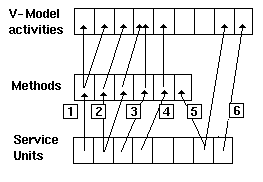
Figure 2.3: Interconnection of Service Units, Methods and Activities
2.3.4 Service Units and Tools
In order to set up an actual SDE the requirements of the service units must be met by means of actual tools. A tool that is to be an integral part of an actual SDE must meet at least the requirements of one service unit; it may also meet the requirements of several service units, though. It is not realistic to expect that all service units are covered by one single tool.
2.3.5 Service Units and Variants
Certain SDE services may be required in different variants. A typical example for this case is the service unit "Linking" for which one variant is required for each programming language when selecting an actual SDE. In this case it is obvious that each tool in question only covers one variant of the service unit.
Variants are only to be used where a complete identical (semantic) functionality for input/output with different syntax is required. Variants are to be taken into consideration in connection with the following service units:
| SUI05 | Editing of Texts |
(e. g. programming language syntax, prose syntax)
|
SUI06
|
Editing of Graphics
|
Variants depend on the syntax of the graphics to be edited
|
SSD12
|
Generating Components and Modules
|
Variants depend on the target language
|
SSD13
|
Generating Databases
|
Variants depend on the database system to be applied
|
SSD14
|
Generating User Interface Formats
|
Variants depend on the TP monitor of the target environment
|
SSD15
|
Compiling
|
Variants depend on the programming language to be processed
|
SSD16
|
Linking
|
Variants depend on the syntax of the object code and on the target system
|
SSD17
|
Debugging
|
Variants depend on the programming language to be processed
|
SQA13
|
Static Assessment of Texts (no Code)
|
Variants depend on the syntax of the text to be assessed | (e. g. prose, formal specification texts)
SQA14
|
Generation of Test Cases
|
Versions depend on the syntax of the object to be assessed
|
SQA15
|
Supporting Dynamic Assessments
|
Variants depend on the syntax of the object to be assessed
| |
2.3.6 Service Units of SD and QA
Some service units of the service complex SD are closely related to its corresponding service units of service complex QA, e. g. SSD05 - Supporting Function Structure and SQA05 - Supporting Assessments of Function Structures. Since actually many QA activities have already been realized during the software generation, the requirements for the two service units cannot always be separated, especially since many tools also take into consideration both aspects.
2.3.7 Interactions between Service Units of the Security Service Complex to the Service Units in other Service Complexes
Some service units in the Security Service Complex are very closely related to Service Units in other Service Complexes, for instance SSEC03 - Access Control with the requirements for access types to SOM01 - Creating, Storing, Administration of Data Structures and Data of the SDE with the requirements for access. The requirements concerned can, therefore, not always be clearly separated according to individual service units, particularly as they must, in practice, normally be covered by one and the same tool.
2.3.8 Notes for the Description of Service Units
In chapter 3, the service units listed in sections 2.3.1 and 2.3.2 are described according to a general schema. This schema is structured as follows:
- Allocation to V-Model and Methods Allocation
This contains a list of the (sub-) products of the (sub-) activities of the V-Model that are supported by the service unit. In case basic methods are intended for these (sub-) activities in the Methods Allocation, they will be listed here as well since the service units will have to support these methods.
The allocation is realized in a common structure:
brief name of the (sub-) activity/long name
(sub-) product
method
Example:V-Model Activities (Products)
SD3.3 - Definition of Requirements for the Functionality
(Technical Requirements.Overall Function of Element")SD4.1 - SW Architecture Design
(SW Architecture)Method
PIM - Process Interaction Modeling
STM - State Transition Modeling - Brief Characteristic
The total service for a certain service unit is explained.
- Requirements
- Requirements for Interfaces
Special requirements for the user interface1, interaction with other service units, consistency requirements to be met - Requirements for the Methods Support
Requirements resulting from the application of certain methods - Requirements for Functions
Requirements on the functions made available by the tool that are not based on a method - Other Requirements
Requirements other than the ones listed above
- Requirements for Interfaces
Links to the V-Model Mailinglist
Mail 0281 - Re: Werkzeugunterstuetzung (281)
|
|
|
 GDPA Online
Last Updated 01.Jan.2002
Updated by Webmaster
Last Revised 01.Jan.2002
Revised by Webmaster
GDPA Online
Last Updated 01.Jan.2002
Updated by Webmaster
Last Revised 01.Jan.2002
Revised by Webmaster
|