 |
 |
 |
|
| 4.6 Elementary Method "Class Responsibility Collaboration" (CRC) |
 4.6 Elementarmethode "Class-Responsibility-Collaboration" (CRC)
 Contents Contents
|
|
|---|
1 Identification/Definition of the Method
/Wilkinson, 1995/
2 Brief Characteristic of the Method
Objective and PurposeThe method is used for the object-oriented system development. It is the objective of the CRC method to detect, check and update the tasks or respectively responsibilities of classes and their collaborations with other classes on a conceptional level. The tasks and responsibilities of a class are the information an object of this class contains, and the actions it can execute. The collaboration of classes show with which other classes a class has to collaborate in order to make available the required functionality. During the methodical check or during the detection of the class responsibilities with the help of a CRC method it is also possible to identify such tasks that are to be processed in collaboration with other classes that possibly have to be specially created.
Means of Representation
CRC cards are essential means to realize the CRC method. Responsibilities or respectively collaboration are entered into these cards, together with other classes.
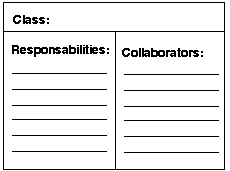
Figure CRC.1: CRC Card
Operational Sequence
When applying the CRC method, class candidates have to be defined first, together with a first specification of the corresponding responsibilities and the actions to be executed by the objects of this class. These classes and actions may, for example, be determined by means of text analyses, reality observations, use cases and scenarios. After that, CRC teams have to be planned. The class design of these CRC teams are discussed and improved in several meetings. During these meetings, each participant gets one of the above illustrated CRC cards; then it will be his task to simulate a class on the basis of a specified problem situation. The class collaboration is discussed during the meetings, normally this results in new classes and additions, regroupings and specifications of existing classes.
3 Limits of the Methods Application
The method CRC can only be applied in combination with method COM. Contributions to V-Model products are delivered via the COM - Class/Object Modeling method.
4 Specification of the Methods Allocation
| No. | Activity | Description |
|---|---|---|
| 4.1 |
SD1.2 Description of Application System |
When applying method COM - Class/Object Modeling, basic class structures can be specified to describe the overall horizon of the system (User Requirements.Preliminary System Description) with the help of the method "Class Responsibility Collaboration". |
| 4.2 |
SD1.4 Definition of Marginal Conditions |
When applying method COM - Class/Object Modeling the class structures can defined with the help of method "Class-Responsibility-Collaboration" to specify technical, organizational and other marginal conditions in User Requirements.Marginal Conditions. |
| 4.3 |
SD1.5 User-Level System Structure |
When applying method COM - Class/Object Modeling the class structures can be professionally improved down to the segment level in subproduct User Requirements.Description of the Functionality with the help of method "Class-Responsibility-Collaboration". |
| 4.4 |
SD2.1 Technical System Design |
When applying method COM -Class/Object Modeling the class structures can be improved and adjusted to consider technical requirements in subproducts: System Architecture.Technical System Structure, System Architecture.Solution Proposals, Technical Requirements.Overall Function of Element with the help of method "Class-Responsibility-Collaboration". |
| 4.5 | SD3.3 Definition of Requirements for the Functionality |
When applying method Class/Object Modeling the class structures can be improved and adjusted to specify functional requirements in subproduct Technical Requirements.Overall Function of Element with the help of method "Class Responsibility Collaboration". |
| 4.6 | SD5.1 Description of SW Component/Module/Database |
When applying method Class/Object Modeling the static structures of components/modules in detailed class structures can be specified or improved in subproducts SW Design (Module).SW Component/SW Module Description and SW Design (Database).Database Description with the help of method "Class Responsibility Collaboration". |
5 Interfaces
| No. | Interface | Observation | Information in Annex 1 |
|---|---|---|---|
| 5.1 | CRC-COM | Method CRC can be applied together with method COM - Class/Object Modeling to detect and improve class structures. |
6 Literature
/Wilkinson, 1995/ Using CRC Cards
|
|
|
 GDPA Online
Last Updated 01.Jan.2002
Updated by Webmaster
Last Revised 01.Jan.2002
Revised by Webmaster
GDPA Online
Last Updated 01.Jan.2002
Updated by Webmaster
Last Revised 01.Jan.2002
Revised by Webmaster
|