 |
 |
 |
|
| 2.2 Representation of the Reference Model of an SDE |
 Contents Contents
|
|
|---|
2.2 Representation of the Reference Model of an SDE
Next, the SDE corresponding to the V-Model will be described by means of a reference model-in short SDE reference model. The structure of the SDE reference model corresponds to the structure of the ECMA reference model [1]; however, it is more detailed in various parts. The SDE reference model particularly formulates precise requirements for the generation of software, the requirements for quality assurance, configuration and project management, in accordance with the V-Model and with the help of the service units. The ECMA reference model only contains very vague or no explanations about these items. In some parts, the "Frameworks" [1] the two reference models deviate with regard to details. A complete comparison between the SDE reference model represented with the help of the service units and the ECMA reference model can be found in Annex B.
The SDE reference model differentiates between two categories of service units:
- the service units predominantly used to support the activities defined in the V-Model. They directly refer to the work of the staff in charge of the development;
- the service units offering general help functions in connection with the development process defined in the V-Model, i. e. with regard to
- object management
- user interface
- workflow management
- guarantee of security.
The service units in question correspond to the "Frameworks" in the ECMA model. In the following paragraphs, they are referred to as general service units.
Fig. 2.2 illustrates a preliminary structure of the SDE whereby the service units of both categories are combined into service complexes.
Next, the individual service complexes will be briefly characterized.
2.2.1 General Service Complexes
Object Management
The service complex "object management" defines the platform- applied to define, store and retrieve all information about the objects utilized during the software development in a data model,
- used to exchange information within the SDE, i. e. between the remaining service complexes, in a controlled way, and
- used to import information into the SDE and to export information from the SDE.
The object management furthermore guarantees
- multi-user tasking
- transaction administration
in the SDE. The impact of object management on the degree of integration to be achieved in an actual SDE is very great.
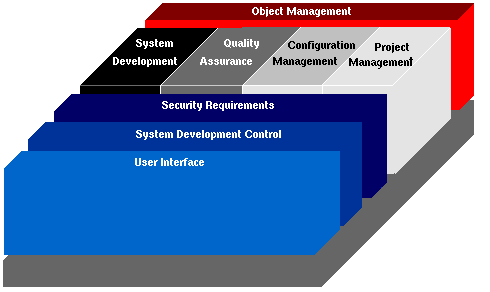
Figure 2.2: Structure of the SDE Reference Model
User Interface
This combines the following services:- message design, user guidance, windowing and scaling
- design versions for user profiles
- help functions for the user
- document design
- alphanumerical processing of documents
- processing of graphics.
Workflow Management
The interaction of all V-Model activities are controlled here. This service complex particularly handles the application of all tools used to realize the service complex "V-Model". Thus the SDE users have access to all other service units, dependent on the context.
Security
This service complex comprises functions for:- guaranteeing the confidentiality of information, i. e. to prevent an undesirable person gaining access to the information e. g. unauthorized personnel having access,
- guaranteeing the integrity of information, i. e. to prevent an undesirable modification of information by unauthorized personnel,
- guaranteeing the availability of information and SDE services,
- guranteeing the liability of message exchange.
- a uniform data management (object management),
- a uniform user interface,
- a uniform exchange of control information.
2.2.2 Service Complexes for the Support of the V-Model Activities
Software Development
This service complex comprises all support functions for the generation of software according to submodel SD of the V-Model. This also refers to the function structuring, to process modeling, information structuring, generation of databases, etc.Quality Assurance
The services for the static and dynamic assessment of products are combined here. Constructive measures with regard to quality assurance are part of other service complexes (in particular part of service complex System Development).Configuration Management
Service complex "Configuration Management" comprises support functions for the configuration planning and control as well as for the version management.Project Management
The services are combined for the following tasks:- planning, steering and control of the system development,
- project-specific administration of available resources,
- tender-relevant tailoring of the V-Model.
Technical elements required for the operation of a computer-based SDE, like computer architecture, network system, office communication, are not described in the SDE reference model. Hardware characteristics have not been considered since only functional requirements are defined in the SDE reference model.
Just as little, services beyond those for a certain project like
- superordinated product resource administration,
- superordinated strategic information planning,
- superordinated quality assurance
|
|
|
 GDPA Online
Last Updated 01.Jan.2002
Updated by Webmaster
Last Revised 01.Jan.2002
Revised by Webmaster
GDPA Online
Last Updated 01.Jan.2002
Updated by Webmaster
Last Revised 01.Jan.2002
Revised by Webmaster
|