 |
 |
 |
|
| 2 Introduction to the Methods Allocation |
 2. Einführung in die Methodenzuordnung
 Contents Contents
|
|
|---|
2 Introduction to the Methods Allocation
The Methods Allocation is not intended as a method manual. Therefore, the description of the methods is as brief as possible. More detailed descriptions can be found in the corresponding definitions and examples referred to.
Various tools support a method often in different, customized versions. Since the Methods Allocation is not to define how certain tools are to be applied, tool-independent definitions must be set up. This implies that the Methods Allocation is limited to the base concept of the methods and does not define rules about the notation (symbols) within the diagrams and the precise syntax of text-related specifications, etc.
Notations are defined within the scope of the operationalization.
The Methods Allocation does not set up rules for activities for which the V-Model intends a flexible process. For example, this is true for the integration activities, SD7 - SW Integration and SD8 - System Integration, where the allocation of methods is "missing" in order to avoid an undesirable and unnecessary limitation of the implemented flexibility.
The following sections explain the basing terminology of the Methods Allocation and the structure and description pattern used for the definition of methods.
2.1 Terminology
The following definition of terms is the basis used to describe, allocate, and delimit the methods of the Methods Allocation.
2.1.1 Methods
Main features of software engineering methods are:- They meet the common definition of "method" ("well-defined and systematically applied procedures in order to meet set goals").
- The method results usually are shown in a characteristic representation; this representation may also be specified.
Software engineering methods are of different complexity and potential. Therefore, the differentiation into complex methods (also: combined methods; method groups) and in elementary methods (also: basic methods) is reasonable and will be specified in the following.
2.1.2 Complex Methods
The term complex methods refers to procedures including different methodical components and integrating them in an overall method. The methodological components as part of the complex methods are not automatically identical with the elementary methods as defined and used in the method allocation. This means that for a component "Information Modeling" from a complex method it must first be verified if the content of the specification matches elementary method ER - E/R Modeling. Ideally, both refer to the same definition source so the equivalent of the elementary method and the methodic components is easy to determine.Complex methods usually cover several aspects of the system (e. g. the functional aspect, the data aspect, etc.; see also Figure 1.1) and several activities of the development (e. g. analysis, preliminary design, etc.).
Examples for complex methods are: SA, IEM
As a whole, complex methods are not part of the Methods Standard. They are described in Annex 2.
2.1.3 Elementary Methods
The term elementary methods refers to the methodical procedures describing a specific, delimited aspect of the system (e. g. functional aspect, data aspect, etc.) and/or a certain section of the software development (e. g. analysis, preliminary design, etc.) or the accompanying activities (PM, CM, QA).In this connection, it is irrelevant whether the basic method is comprised of several steps and possibly generates several (sub-) results (example: DFM - Data Flow Modeling) or the basic method exactly generates one result (example: Decision Table Technique).
Examples for basic methods are: ER - E/R Modeling, STM - State Transition Modeling
Basic methods are allocated to individual V-Model activities and (sub-) products in the Methods Standard (see Figure 2.1).
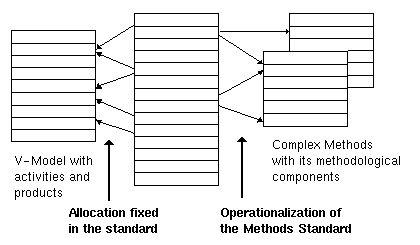
Figure 2.1: Overview of Functions in Submodel SD
When applying a complex method it must be represented within the scope of the operationalization that the methodical components of the complex method meet the requirements of the basic methods described in the Methods Allocation. To do so, the three steps described in chapter 1.3 Application of the Methods Allocation have to be carried out.
2.1.4 Categories of Methods
The term category of methods refers to those basic methods that apply different methodical approaches for the solution of a certain family of activities or problems. The common characteristics of these basic methods are defined in the Methods Allocation. The individual potential methods of each category are described in more detail in Annex 1 to the Methods Allocation.Examples for categories of methods are: design verification, estimation models, reliability models.
To specify a category of methods in the Methods Allocation means that the application of one method is required from this category.
2.1.5 Method Interfaces
When applying several basic methods during the development process the reference points might occur in the following form:- The results of one basic method have to be balanced against the results of another basic method.
- One basic method has to be directly integrated at a certain position into the operational sequence of another method.
- In case two basic methods run sequentially, a piece of information is transmitted from one method to another, and thereby possibly transformed.
Examples for method interfaces are: interface DFM - Data Flow Modeling - ER - E/R Modeling, interface CFM - Control Flow Modeling - STM - State Transition Modeling.
The characterization of the method interfaces is part of the Methods Allocation. Annex 1 to the Methods Allocation includes a detailed description of the individual interfaces.
2.2 Structure of the Methods Standard
The basic elements of the Methods Allocation are the allocation tables of basic methods to (sub-) activities and (sub-) products of the V-Model as well as the descriptions of the individual basic methods.
2.2.1 Allocation Tables
Chapter 3 Allocation Tables of the Methods Allocation comprises the allocation tables that are structured according to the four submodels.The allocation tables have the following structure for each main or subactivity of the V-Model which are no further hierarchically partitioned (see Figure 2.2):
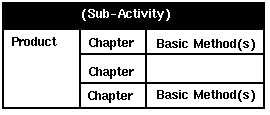
Figure 2.2: Methods Allocation, Allocation Table
For the chapters of a product that is generated by the corresponding (sub-) activity the basic method which has to be applied during its generation is referred to.
If the table does not include an entry for a V-Model (sub-) activity or for a V-Model product or chapter, no further regulation is required by the Methods Allocation beyond the V-Model.
For each basic method a unique abbreviation exists which is used for the identification in the table entries. Chapter 2.3 Method Overview contains an overview of all these abbreviations.
2.2.2 Explanation of Footnotes and Nomenclature in the Tables
If one basic method is only to be used under certain conditions, a reference is made in the allocation table by means of a footnote. The number of the footnote is found right after the corresponding method.The text of the footnote informs about the manner of limitation.
If several basic methods are listed for one (sub-) chapter it will be explained if these are alternatives or if the methods are required to be complementary:
- In case of alternative methods the slash "/" is used. The number of the footnote follows right after the slash. The text of the footnote informs about the criteria for the alternative application.
- In case of complementary methods the plus-sign "+" is used. In the description of the corresponding methods an explanation is given to which part of a section which (sub-) entry is referred to.
If the entry into the left column of the table contains a Space " ", this refers to the fact that the methodological standardization does not refer to a certain product, but to the realization of the entire activity.
2.2.3 Description of the Methods
Chapter 4 of the Methods Standard includes the following additional information for each of the methods listed in the allocation tables:- Identification/Definition of the Method
Reference to a definitely to be complied definition of syntax and semantics. - Brief Characteristic of the Method
Description of objective and purpose, means of representation and operational sequence of the method. - Limits of the Method Application
Criteria when it is not advisable or only partly advisable to apply the method, or the application becomes limited within the scope of the V-Model. - Specification of the Methods Allocation
Here explanations are given of all those facts that are relevant for the application of a method at a certain stage in the V-Model. - Interfaces
Information about the interfaces to be considered to other basic methods. - Further Literature
2.3 Method Overview
The following table contains a list of all abbreviations for basic methods and categories of methods used in the allocation tables (chapter 3). Furthermore, a reference is made to the corresponding description of the method in chapter 4.
|
|
|
 GDPA Online
Last Updated 01.Jan.2002
Updated by Webmaster
Last Revised 01.Jan.2002
Revised by Webmaster GDPA Online
Last Updated 01.Jan.2002
Updated by Webmaster
Last Revised 01.Jan.2002
Revised by Webmaster
|