 |
 |
 |
|
| 1 Objective and Application of the Methods Standard |
 1. Zielsetzung und Anwendung der Methodenzuordnung
 1.1 Objective
Together with the V-Model (GD 250), the Methods Allocation is to regulate the application of methods for the development of software SD and the accompanying activities Quality Assurance (QA), Configuration Management (CM), and technical Project Management (PM).
The Lifecycle Process Model (V-Model) answers the question "What is to be done?", i. e. the V-model describes the activities and products of a software development process, whereas the Methods Standard answers the question "How is it to be done?", i. e. the Methods Standard determines and describes the methods for the activities and products carried out and generated during the software development process. Therefore, the Methods Standard directly supports the objectives of the V-Model.
Furthermore, the Methods Standard will help to meet the following goals connected with the realization of projects:
- The definition of a limited number of methods makes it easier for the Project Management to make the selection.
- Thus a complex, repeated evaluation and selection of methods is no longer required. Future updates of the Methods Allocation guarantee that the contained methods are always up-to-date.
- The selection and application of tools is supported by the definition of methods to be applied, and the investment made in tools will be protected.
- The training efforts required for the software development team can be better estimated.
- Method-specific interim products resulting from the software development process can now be compared and evaluated.
- Method-specific documents from QA, CM and PM can now also be compared and evaluated.
1.2 Subject of the Standardization
The Methods Standard regulates the application of methods in a general way. In order to achieve this kind of general standard the Methods Standard is limited to the definition of basic methods. Normally, such basic methods can be found in various interpretations between the different commercially propagated methods-so-called complex methods-which represent a well-defined combination of several basic methods (see also chapter 2.1 Terminology). Figure 1.1 illustrates an allocation by the example of the complex methods SA (Structured Analysis) and IEM - Information Engineering Method to some basic methods.
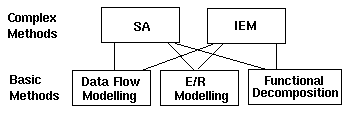
Figure 1.1: Example "Complex Methods"-"Basic Methods"
The limitation to the level of basic methods guarantees that the Methods Allocation does not prejudice decisions which are only based on technical marginal conditions (e. g. the functionality of certain tools).
This way it can also be guaranteed that each method referenced in the Methods Allocation is explicitly described or respectively defined in a generally accessible documentation.
When selecting the methods, the following principle was applied:
- Limitation to those methods having reached a high degree of maturity and acceptance.
- Preferring methods for which tool support is available, whenever possible and practical.
- Selection of methods that can be combined in an application.
1.3 Application of the Methods Allocation
The activities of the V-Model and the products there created are the basis for the application of methods from the Methods Allocation.The Methods Allocation includes Allocation Tables listing those basic methods that are best suited to realize certain activities or to develop products according to the latest state-of-the-art and by observing the following criteria:
- quality improvement,
- economy,
- maintainability.
When realizing a certain V-Model activity or when generating a V-Model product, the allocated basic methods must be applied, unless
- limiting conditions have been listed in connection with the allocation in the Methods Allocation which might make the application of that method impractical,
- explicit arguments have been listed which might advise against the selection of the corresponding method or for application of an alternative method in a special case.
In the tables, basic methods are only allocated to part of the V-Model activities/products. This means that in an actual case (e. g. an actual project) it is possible to decide if other methods that go beyond the ones defined in the standard are to be applied as well.
All decisions deviating from the default of the Methods Allocation (renouncement, change, upgrade) must become a matter of record that can be proved. In this connection, the deviation must meet the quality requirements of the application (e. g. the project). With regard to method results that are part of the phase documentation the process must be restrictive.
For each method referenced in the allocation tables, chapter 4 of the Methods Allocation describes the features an applied method must include in order to reach the standard. Since as a rule not the actual basic method itself but a "complex" method will be applied, the standard is the instrument to verify whether the complex methods to be used will fit.
The evaluation of the standard conformity is realized in three steps:
- Identification, which component of the offered complex method is to meet the required basic method (the conformity of names may be helpful in some cases, but often it may also be misleading!).
- Check to which extent the corresponding component includes the characteristics represented in chapter 4 of the Methods Allocation. In this connection it must be observed that the functionality of the methods usually applied go beyond the requirements of the Methods Allocation.
- Check if the planned application of methods meets all requirements of the allocation tables. Many of the basic methods are referenced at different positions in the allocation tables, i.e. they have to be applied several times. When using complex methods, this must be taken into consideration.
The Methods Allocation is not meant as an instruction for individual project members but is to be used as a work basis for the actual definitions to be made within the scope of the operationalization by the personnel in charge (see section 1.4 The actual Definition of the Methods to be applied).
1.4 The actual Definition of the Methods to be applied
The actual definition of type and scope of the methods to be applied is realized for each homogeneous application spectrum in two steps:
- As a result of the tailoring of the V-Model (in this connection, certain products and activities are generally canceled) all those methods are canceled that had been allocated to the canceled activities/(sub-) products listed in the allocation table of the Methods Allocation.
- For the remaining basic methods a definition is made (procedure according to section 1.3 Application of the Methods Allocation) with regard to the complex methods required to cover them for the actual application spectrum.
1.5 Roles of the Annexes
The annexes to the Methods Allocation comprise:
- Annex 1: Explanations and examples to the basic methods, categories of methods, and method interfaces.
- Annex 2: Description of the most important complex methods and their allocation to the basic methods.
Links to the V-Model Mailinglist
Mail 0200 - Re: Methodenzuordnung fuer UML (200)
|
|
|
 GDPA Online
Last Updated 01.Jan.2002
Updated by Webmaster
Last Revised 01.Jan.2002
Revised by Webmaster
GDPA Online
Last Updated 01.Jan.2002
Updated by Webmaster
Last Revised 01.Jan.2002
Revised by Webmaster
|