 |
 |
 |
|
| Annex 2 | |||
| 2.5 The complex Methods SA and SA/RT |
 SA/RT - Structured Analysis with Real-time-Extensions
 Contents Contents
|
|
|---|
1 Brief Description
SA (Structured Analysis) and SA/RT (Structured Analysis with Real-time-Extensions) are complex methods which today belong to the most frequently applied methods for the system analysis. RT or respectively the RT model is no independent method but an upgrade of SA including real-time-specific elements; therefore it does not make sense to consider RT separately. In the following, SA/RT is thus referred to as the general term.
Both SA and SA/RT have several versions that are also found in the tools. For SA, the versions according to /DeMarco, 1978/ and /Gane, 1979/are relevant, the relevant versions for SA/RT are the descriptions in /Ward, 1985/ and /Hatley, 1987/. The following brief description refers to the works of DeMarco and Hatley/Pirbhai the way they are described in /Hatley, 1987/; the differences to the other authors are small and will be explained in chapter 5.
SA or SA/RT support the main activities SD1 - System Requirements Analysis to SD3 - SW/HW Requirements Analysis, i. e. all three levels of the requirements analysis. While SA is not restricted to a special scope of application, SA/RT is predominantly applied in technical, real-time-oriented applications. The components of the complex method SA are:
- data flow diagrams,
- process hierarchy,
- means to represent the process specification:
- decision tables (alternatively: decision trees),
- structured text,
- formulas,
- diagrams,
- labeled graphics,
- data dictionary.
In addition, the complex method SA/RT contains the following components:
- control flow diagrams,
- means to represent a finite automaton, e. g.
- state transition diagrams,
- state transition tables,
- decision tables (as special form of an automaton with only one state),
- means to represent time efficiency requirements, e. g. time diagrams.
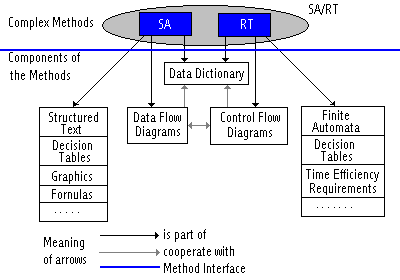
Figure 2.1: Overview Diagram Complex Methods SA and SA/RT
2 Tabular Comparison
The following table compares the basic methods of the GD 251 with the methodical components of SA and SA/RT. In the case where there is no entry in the right column of the table, SA and SA/RT have no corresponding component. Otherwise, an entry refers to the corresponding part in the SA and SA/RT literature. The entry is explained in section 3 of the comparison. Entries identified with (*) refer to basic methods completely covered by SA and SA/RT. These are not further described in section 3.
Note:
The right column of the table contains the names of several authors. This has to be interpreted in such a way that an application of SA or respectively SA/RT is possible according to any one of these authors.
3 Specification of the Allocation
| Method | Corresponding Component in SA | Explanation |
|---|---|---|
|
FCTD Functional Decomposition |
Process Hierarchy /Hatley, 1987/ chap. 12.1, /Gane, 1979/ chap. 4 /Ward, 1985/ volume 2, chap. 5 and 6 | If the data flow model with its hierarchical process structure is generated prior to a function tree (according to FCTD), a function tree can still be generated by extracting the processes from the data flow model and recording to them as separate tree. This tree can then be used as the basis for a function tree. This function tree is frequently upgraded by additional functions (e. g. organizational functions or manual activities) that are essential for the corresponding project. |
4 Information about individual Components
- 1. Data Dictionary
SA and SA/RT cooperate with a central data-dictionary for all items identified in connection with modeling processes. However, in connection with the data only data flows and stores are decomposed into individual parts, the interrelation of the data is not taken into consideration. Today, this disadvantage can be compensated with the application of the E/R modeling-in particular in connection with the development of information systems. Even though E/R is not a component of the complex method SA or respectively SA/RT it makes sense to model the SA or SA/RT data with the E/R data model. The data structures are then a result of the E/R modeling process (compare basic method ER).
The data management itself is predominantly the task for a tool. The specification of certain notation forms for the data definition must also be considered as beyond the regulation by the Methods Standard. - 2. Control Specification and State Transition Modeling
Control flow diagrams merely illustrate which processes are interacting via control flows and if a control flow has the character of an input or output value. The control specification is generally a finite automaton with output. Control flows are thus the input and output information controlling the participating processes, depending on the system states.
A number of representations are possible for finite automata with output, the description of the basic method STM contains a corresponding list. In case the number of states degenerates to 1, it is a combinatorial automaton. The common way to represent combinatorial automata is the decision table (see basic method DTAB). The automata themselves can be linked with each other, with regard to a control specification of a higher complexity (e. g. the process activation table according to /Hatley, 1987/.) This way, however, the representation of the RT model can be simplified.
The time efficiency requirements are part of the control specification. The RT model knows two types of external time requirements:
- Response time: The required maximum time period between receiving an event and the reaction of the system is entered into a table.
- Repeat rate: Two different rates are possible. The frequency of relevant external signals or the frequency of signals generated by the system are specified. The last mentioned rate thus refers to the frequency a system process is repeated.
5 Further Information
5.1 SA and SA/RT Versions
- SA according to Gane/Sarson:
The definition of SA in Gane/Sarson /Gane, 1979/ differentiates mainly with regard to the notation of the one in DeMarco. The meaning of the representation elements process, store, data flow, external item is identical in both approaches.
Differences:
- The rules with regard to the labeling of diagrams are more detailed in Gane/Sarson than in DeMarco.
- Gane/Sarson contains additional material flows.
- The context diagram with one single "system process" is not definitely required in Gane/Sarson. An overall data flow diagram rather combines all processes on the upper modeling level, together with the external items.
- SA/RT according to Ward/Mellor:
The method description for SA/RT listed in this annex is based on the works of /Hatley, 1987/. An alternative approach for an RT upgrade can be found in /Ward, 1985/.
While in /Hatley, 1987/, CFM and the process specification are representing the RT upgrade, /Ward, 1985/ introduces
- control processes,
- event flows, and
- buffers.
The event flows are similar to the data flows of the DFM. They are different from the control flows of the CFM because an event flow can only transport a constant value, i. e. an event flow rather corresponds to a switch than to a control channel with possibly variable information.
5.2 Further Development of SA and SA/RT
Today, the terms "Modern Structured Analysis" /Yourdon, 1989/, "Advanced Structured Analysis" /Peters, 1988/ etc. refer to a number of publications about the further development of SA and SA/RT.
/Yourdon, 1989/, e. g. summarizes the know-how and experience with regard to the structured analysis since the publication of /DeMarco, 1978/. Though a new method is not really propagated, SA and SA/RT are seen in the entire SW engineering environment. In this connection, the interrelation of individual methodical components as well as the transition to the SW design play an important role. Furthermore, it is considered as state of the art to apply method E/R together with SA or respectively SA/RT within the scope of information modeling.
6 Literature
/DeMarco, 1978/ Structured Analysis and System Specification/Gane, 1979/ Structured Systems Analysis - Tools and Techniques
/Hatley, 1987/ Strategies for Real-Time System Specification
/Peters, 1988/ Advanced Structured Analysis and Design
/Ward, 1985/ Structured Development for Real-Time Systems
/Yourdon, 1989/ Modern Structured Analysis
|
|
|
 GDPA Online
Last Updated 01.Jan.2002
Updated by Webmaster
Last Revised 01.Jan.2002
Revised by Webmaster
GDPA Online
Last Updated 01.Jan.2002
Updated by Webmaster
Last Revised 01.Jan.2002
Revised by Webmaster
|