 |
 |
 |
|
 |
|||
| QA 4: Product Assessment |

 Contents Contents
|
|
|
|---|
Product Flow
| From | Product | to | Methods | Tool Req. | Ext. Norms | |||
|---|---|---|---|---|---|---|---|---|
| Activity | State | Chapter | Title | Activity | State | |||
| SD, QA, CM, PM |
accepted | All | Existing products required for the Consistency Assessment | - | - |
/ISO IEC 12207/
Supply Proc.: Devlp. Proc.: Operation. Proc.: Maintenance. Proc.: Doc. Proc.: Audit Proc.: |
||
| SD, QA, CM, PM |
submitted | All | Objects to be assessed | SD, QA, CM, PM |
being proc./ accepted |
REV SIMU (1)/ (2) STAT (3) T (4)/ (5) |
||
| QA1 | accepted | All | Assessment Plan | - | - | |||
| QA2 | accepted | All | Assessment Specification | - | - | |||
| QA2 | accepted | All | Assessment Procedure | - | - | |||
| - | - | All | Assessment Report | QA5 | - | |||
 + "Chapter" are extra columns from the original printed version of GD 250
Handling
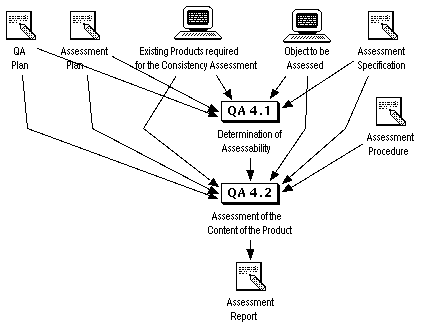
Figure 5.6: QA4 - Product Assessment
If activity QA4.1 - Determination of Assessability results in a negative decision (assessability is not possible) then the object to be assessed is returned to SD, QA, CM or PM and has to be revised.
The Assessment Report is the result of the product assessment with regard to the contents; it shows among other things whether the product has been given the state "accepted" or "b. proc.".
The project management is to be informed about the assessment result.
It is important to state at this point that the object to be assessed must not have been created by the Assessor himself.
Roles
| Role | Participation | ||
|---|---|---|---|
| Assessor | responsible (QA4.1,
QA4.2)
| QA Manager |
cooperating (QA4.1)
| |
Sub-activities
QA4.1 - Determination of Assessability, QA4.2 - Assessment of the Content of the Product
Tools Requirements
Being defined
External Norms
| Norm | Process | Chapter | Obs. |
|---|---|---|---|
| /ISO IEC 12207/ | Supply Process | Review and Evaluation | (s. Part 3 - ISO 3.2.1) |
| Development Process | System Requirement Analysis | (s. Part 3 - ISO 3.2.1) | |
| System Architectural Design | |||
| Software Requirement Analysis | |||
| Software Architectural Design | |||
| Software Detailed Design | |||
| Software Coding and Testing | |||
| Software Integration | |||
| Software Qualification Testing | |||
| System Integration | |||
| System Qualification Testing | |||
| Operation Process | Operational Testing | (s. Part 3 - ISO 3.2.1) | |
| Maintenance Process | Maintenance Review/ Acceptance | (s. Part 3 - ISO 3.2.1) | |
| Documentation Process | Design and Development | (s. Part 3 - ISO 3.2.2) | |
| Audit Process | Audit | (s. Part 3 - ISO 3.2.2) |
Links to the V-Model Mailinglist
Mail 0345- AbnahmeMail 0278 - Re: Organisationseinheiten im QS-Plan / Pruefplan
Mail 0271- Re: SE 9 Ueberleitung in die Nutzung
Notes: (1) Method SIMU is to be applied if reliability requirements are high nd the use conditions are so complex that static investigations with regard to feasibility and resource requirements are not sufficient.
(2) Method SIMU is to be applied if the test cannot completely handle the performance and error proof since - among other things - special limitations, assumptions, and environmental conditions have to be taken into consideration.
(3) Methode STAT is to be applied if contents of the object to be assessed are structured according to a standard formalism.
(4) Method T is to be applied if contents of the object to be assessed are structured according to a specified formalism allowing a dynamic execution.
(5) Method T is to be applied if automated assessment procedures are to be used.
This page online
•
GDPA Online
•
Last Updated 07.Feb.2003 by
C. Freericks