 |
 |
 |
|
 |
|||
 |
 GPO Zusammenhang zwischen Geschäftsprozeßoptimierung und dem V-Modell
 BPR.1 Business Processes and IT Systems
Information Technology (IT), comprising all technical means for processing or transmitting information, can be considered as the basic innovation of the closing years of the twentieth century. In this connection, information is often referred to as the basic "raw material" of a post-industrial society ("information society") where the processing of information and communication are integral parts of all business processes within the scope of the generation of productivity. Seen like this, the IT support of the realization of business processes, that are both time and know-how sensitive, are helping to trim down administration and to get closer to the public.
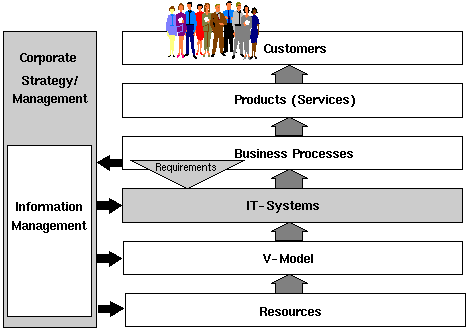
Figure BPR1: Business Processes, IT Systems and V-Model
Strategically, business processes are all the more important when, as seen from today's (and from a future point of view), they contribute to the net product value increase. The importance of business processes for achieving the business goals of an organization also rates the supporting IT systems with a higher value in the corporate context. Therefore, efficiency and effectiveness of corporations and authorities are influenced by the pointed utilization of IT, in particular since requirements of supporting IT systems can be deviated from the business processes.
The generation and procurement of IT systems used for the support of business processes is, therefore, an important and critical factor. Information management of corporations and public authorities ought to give it their special attention in connection with strategies. The technical handling of generating and procuring the necessary IT systems is regulated in the V-Model.
BPR.2 Organization Development and Business Process Reengineering
With regard to the approach towards the optimization of business processes, it is possible to differentiate between two extreme procedures which are opposed as "final products of an entire continuum" of possible interim forms:
- 1. organization development
- 2. business process reengineering (BPR)
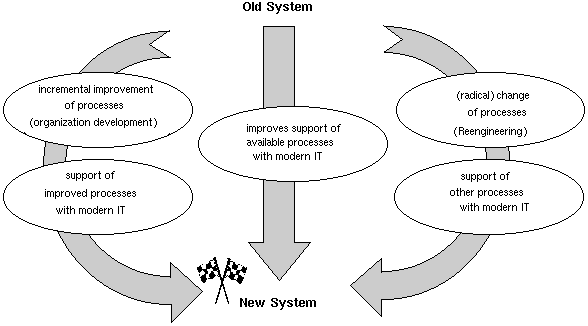
Figure BPR 2: Organization Development vs. Business Process Reengineering
The BPR, however, aims to change radically the existing processes. The initial question is: what can be changed? Available processes are basically doubted, and new approaches for business processes are looked for. The system as a whole will be dramatically altered in order to achieve improvements of significant dimensions. With regard to IT this means that completely different processes have to be supported that was the case in the past.
Between the two extreme points there is an area where-according to traditional approaches-the attempt was made to improve existing processes with modern IT. This area is dangerous, however, since existing, but inefficiently organized business processes will be automated at great cost and effort. Therefore, when developing and procuring (also when changing, though) information systems, management should always take into consideration the factor that organization of the business processes to be supported must still meet present day requirements. According to which approach-"incremental improvements" or "radical changes"-a decision is made depending on the opportunities, and must in each case be decided by management. Within the scope of a far-reaching, continuous improvement program it will not be difficult to imagine that both procedures can be combined. To do so the existing business processes will be looked into and called in question after some prolonged periods. During these intervals the attempt is made, however, to continually optimize the processes by means of an incremental process handling.
BPR.3 System Requirements Analysis and Business Process Reengineering
The User Requirements are the starting point of the regulations in submodel SD of the V-Model. These user requirements result also from a business process analysis or from an optimization. The following is to show that actual connections exist. Activity SD1 - System Requirements Analysis, is used as the initial starting point. Method BPR (Business Process Reengineering [Geschäfts-Prozeß-Optimierung]) is the basis for the business process analysis.
A business process analysis results in a number of data that can be utilized later in the system generation. Though a business process analysis predominantly concentrates on the process itself, the business process reengineering (BPR) takes the system to be realized later into consideration as early as this. The integration of off-the-shelf products also plays an important part. One of the central parts of the BPR investigation is who handles which process with which resources.
In this connection, resources of the most varying kinds may be used. It is the objective of the optimization based on the analysis to find out in which way these computer-aided resources may simplify the processes. If the corresponding characteristic numbers refer to an IT system development, then the results of the BPR will be used in the individual products of submodel SD. The organizational embedding of the future system will be taken into consideration.
BPR.4 Relevant Activities and Products
Products integrated into activities SD1 - System Requirements Analysis and SD2 - System Design are
- external specifications and
- product information.
- Who is to work with the completed system, which requirements therefore exist both with regard to operability and the required network structure.
- On which existing or still to be procured hardware is the system to run.
- The special requirements already available are the central point. Therefore an essential part of the product User Requirements to be generated with activity SD1 - System Requirements Analysis already exists as well. In this connection, special requirements are most important; the technical aspects are not considered.
- The ACTUAL recording in the BPR also investigated which software already exists and shall be further used.
- Another result of the BPR is the information about which company-internal standards exist and have to be taken into consideration during the development or respectively during the purchase of future systems.
- Since a BPR always considers a business process as an entire unit, the interfaces used in a process also become noticeable. Therefore initial information for the products Interface Overview and Interface Description are also available.
BPR.5 General BPR Information
The approach during the realization of the BPR should be direct, i. e. during the analysis of the business processes, from the procedure to the performance to be expected, and also during the generation of the business process, from the performance to the business process. This approach has been illustrated in BPR 3: Structure and Analysis of Business Processes.
Based on this approach it is possible to get a clear idea which items of information are important for the V-Model and which results merely figure as marginal information. Marginal information is obtained when observing the structure of the business process, information relevant for the V-Model, however, is obtained during the analysis of the business process.
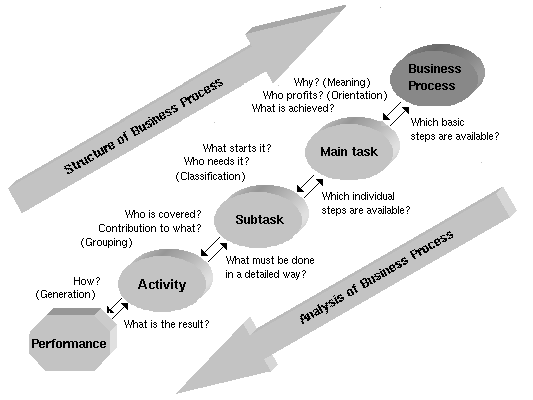
Figure BPR 3: Structure and Analysis of Business Processes
|
|
|
This page online • GDPA Online • Last Updated 03.Mar.2004 by C. Freericks |