 |
 |
 |
|
| Annex 1 | |||
| 4.3 Interface DFM-ER |
 Contents Contents
|
|
|---|
1 Characterization of the Interface
The interface corresponds to the type "balancing against the results of another basic method".
The data flow model is generated interactively with the E/R model. In this connection, individual elements of the data flow model are allocated to sections of the E/R model, so-called "views". The E/R submodels can then be allocated
- to the DFM processes,
- to the data flows (internal and external data flows), as well as
- to the stores.
By means of the interactive adjustment on the process and data side the attempt is made to meet the requirements on completeness (e. g. "have all functions been supplied with the required data, etc.") and consistency (e. g. "are there data or functions that are not in interaction with any element or with the wrong elements"). The interface is also applied to optimize processes (e. g. minimizing the interface relationships).
2 Example
Figure 4.4 illustrates the interface relationship.
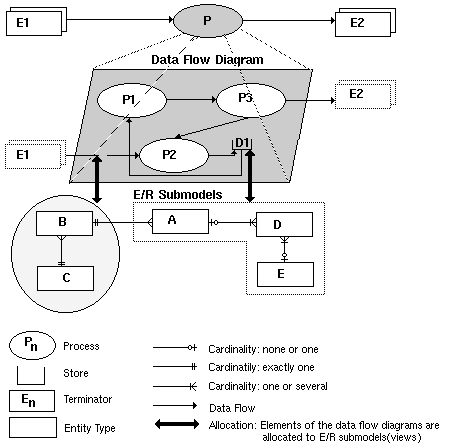
Figure 4.4: Example Interface DFM-ER
Explanation of the example:
Apart from the context diagram with the terminators E1 and E2 the first refinement of the data flow diagram is also illustrated in the example. In this connection, a view with entity types B and C is allocated to the data flow from terminator E1 to process P2. Thus the interface between E1 and P2 is recorded. Furthermore, a view with the entities A, D, and E is allocated to data store D1. This can be used to structure data store D1.
3 Tool Support
In order to ensure consistency of the E/R submodels with the total E/R model the tool support is particularly required in the case of large models (ER and DFM).
4 Literature
| /Achatzi, 91/ | chap. 5 : Detailed information about the functional structuring in connection with data aspects. |
| /Raasch, 91/ | chap. 4.4.4.5 explains the relationship types in the SA model. |
|
|
|
 GDPA Online
Last Updated 01.Jan.2002
Updated by Webmaster
Last Revised 01.Jan.2002
Revised by Webmaster
GDPA Online
Last Updated 01.Jan.2002
Updated by Webmaster
Last Revised 01.Jan.2002
Revised by Webmaster
|