 |
 |
 |
|
| Annex 1 | |||
| 4.18 Interface PIM-STM |
 Contents Contents
|
|
|---|
1 Characterization of the Interface
The interface corresponds to type "balancing against the results of another basic method". According to footnote 19) in the Methods Standard, only the complex processes of a PIM - Process Interaction Modeling are specified via STM - State Transition Modeling. In this connection, each signal connected with such a process is accordingly listed in the STM description of the process at least once.
With regard to completeness and to the succeeding verification it is recommended, however, to describe all PIM processes via STM.
Changing the aspect is an important interface feature: while all the state transition diagrams of the individual processes illustrate the static model of the projected software, the PIM demonstrates the actual dynamic (generally a subset of all possible sequences) in its chronological and/or logical order. In this connection the PIM processes are practically considered as "black box", and the STM processes as "white box".
2 Example
The two following illustrations demonstrate-by means of a solution of the reader/writer problem according to /Buhr, 1984/, pp. 157-163-the correspondence of PIM signal sequences with the corresponding state automation. The solution according to /Buhr, 1984/ assumes that the processes "reader" and "writer" are controlled by process "scheduler" in order to prevent collisions during the reading/writing of the shared memory. Several read processes are possible simultaneously; write processes are realized individually and exclude all other processes.
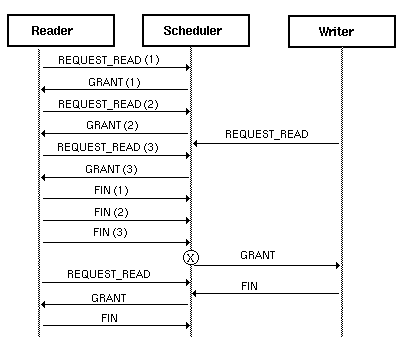
Figure 4.27: Process Interaction Diagram for the Reader/Writer Problem
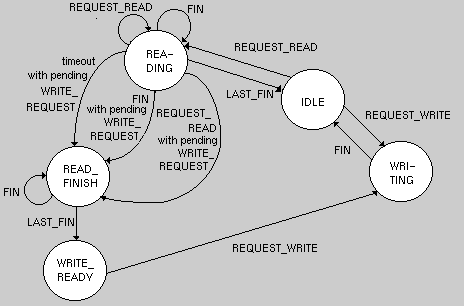
Figure 4.28: State Automaton for Scheduler Process of the Reader/Writer Problem
Figure 4.27 illustrates a typical signal sequence the way it may occur in the course of concurrent processes. The "scheduler" must be structured in such a way that it controls the access of "reader" and "writer" to the shared memory in all situations according to the requirements. This has been illustrated in Figure 4.28 (example from /Buhr, 1984/ ). To be easily surveyed, it does not contain the acknowledgment signals ("grants") sent by the "scheduler" to the requesting processes for the coordinated activation (note: in the Ada formulation of the example (see /Buhr, 1984/ chap. 5.3.3) the "grants" are implicitly included in the rendezvous mechanism).
The example illustrates the balancing of the methods by means of common names for the corresponding signals in both diagrams.
3 Tool Support
Tool support is often rendered in a way that possible sequences are generated from state diagrams. The selection of relevant sequences and its representation by PIM must then be realized from the generated sequences.
With regard to modeling via communicating state automata for which tool support is available, the approaches according to /Harel, 1987/ and the section "Process Diagrams" from SDL (s. /SDL, 1985a/) must be particularly mentioned.
4 Literature
| /Buhr, 1984/ | Chap. 5.3.3, 5.3.4 describe several solutions for the Reader/Writer problem which also illustrate interface PIM-STM. |
| /Harel, 1987/ | Chap. 5 describes the interaction of signals and states in case of communicating automata. |
| /SDL, 1985a/ | The example in chap. 3.3.1 illustrates the utilization of signals in SDL processes. |
|
|
|
 GDPA Online
Last Updated 01.Jan.2002
Updated by Webmaster
Last Revised 01.Jan.2002
Revised by Webmaster
GDPA Online
Last Updated 01.Jan.2002
Updated by Webmaster
Last Revised 01.Jan.2002
Revised by Webmaster
|