 |
 |
 |
|
| Annex 1 | |||
| 4.11 Interface ER-LOGM |
 Contents Contents
|
|
|---|
1 Characterization of the Interface
The interface corresponds to type "information transmission from one basic method to another in sequential order". The information is transmitted from ER - E/R Modeling to LOGM - Logical DB Modeling.
In this case, the complete E/R model from SD3.4 - Definition of Requirements for the Quality of the SW/HS Unit is transformed by the LOGM basic method into a DBMS-oriented data structure.
DBMS-oriented data structures can be hierarchical, network-oriented or relational data structures without the special characteristics of physical storage parameters of commercial database systems, though. The required rules for the above mentioned transformation have also been described in /Batini, 92/ p. 309-404 and in /Atre, 80/ chap. 6.
2 Example
The following example lists the most important steps required to transform an E/R model into a hierarchical data structure. The corresponding details are found in /Atre, 80/ p. 163-174.
| Step 1 | Elimination of unnecessary transitive relation types between entity types in the E/R model. Therefore, the relation type in Figure 4.14 from A to C is unnecessary if it does not cause semantic information to be lost. |
| Step 2 | Deviation of all hierarchical relation types from the E/R model (/Atre, 80/, p. 165). |
| Step 3 | Dissolution of multiple hierarchical dependences in the E/R model. Situations as shown in Figure 4.15 must be dissolved during the transformation into hierarchical data structures. Depending on the type of the hierarchical "parents", several possibilities exist (compare /Atre, 1980/, p. 167-172). |
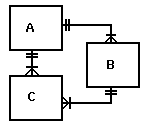
Figure 4.14: Elimination of Transitive Relation Types

Figure 4.15: Dissolution of Multiple Hierarchical Dependences
3 Tool Support
A large number of commercially available tools generate DBMS-oriented data structures as internal interim steps in order to utilize it directly as a basis to generate the database structures with physical parameters for commercially available database systems. Exceptions are constituted by tools creating general relational data structures.
4 Literature
| /Atre, 1980/ | Contains a comprehensive description of the rules for the logical data modeling in chapter 6 (Logical Model) |
| /Batini, 1992/ | Contains the most complete description of the logical data modeling that can be found in the literature at present in section 3 (chap.11, 12, 13, 14). |
|
|
|
 GDPA Online
Last Updated 01.Jan.2002
Updated by Webmaster
Last Revised 01.Jan.2002
Revised by Webmaster
GDPA Online
Last Updated 01.Jan.2002
Updated by Webmaster
Last Revised 01.Jan.2002
Revised by Webmaster
|