 |
|
| Process Plan |
A-B-C- D-E-F- G-H-I- J-K-L- M-N-O- P-Q-R- S-T-U- V-W-X- Y-Z
 Identification
Process Plan
Also as
Software Process Plan
Definitions/Uses
| 1998 | |
|---|---|
| Reference | /Huff, 1988/ A Plan-based Intelligent Assistant that Supports the Software Development Process |
| Definition/ Use |
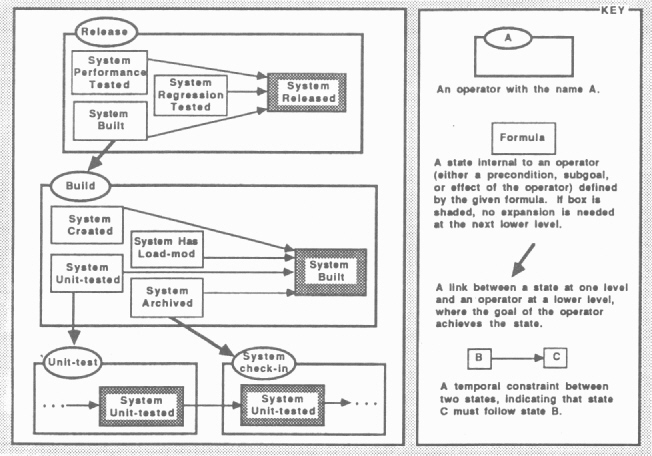
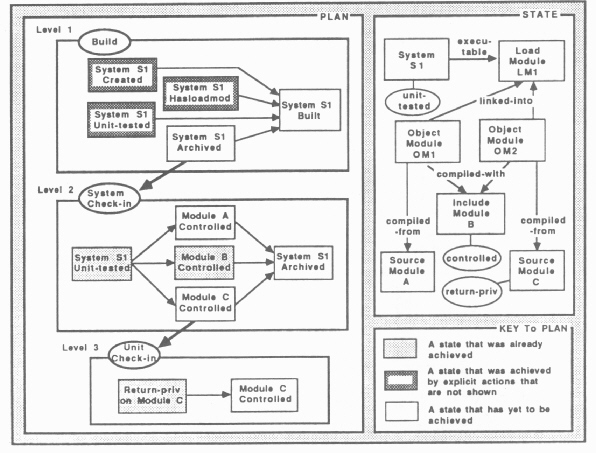
A plan is a hierarchical, partial order of operators (with bound parameters) that achieves a goal given an initial state, and plan recognition, where a plan and its goal are inferred given a sequence of actions and an initial state.
Plans are constructed dynamically by instantiating operators. Operators definitions contain sufficient information to reason about sequences of actions without actually executing the actions. The state changes that an action causes are explicit; therefore, sequence of actions can be "simulated". The exact preconditions of an action are explicit; therefore, actions can be order correctly. Concurrency is implicitly allowed, subject only to the stated preconditions. Plans are automatically tailored to the exact context for which they are needed. If a subgoal has already been achieved as a side-effect of prior activity, actions to achieve that subgoal will be omitted. If a part of the plan fails during execution, replanning will fill the gaps left by the failure (and only those gaps).
|
| 1993 | |
| Reference | /Feiler, 1993/ Software Process Development and Enactment: Concepts and Definitions. |
| Definition/ Use |
A specification of the resources necessary for the enactment of a process definition, the relationships of these resources to process steps, the products produced by these steps, and any constraints on enactment or resources. Process plans guide the instantiation and use of processes while project plans guide the design, development, evolution, and tailoring of processes (or products). |
Related terms in the glossary
Plan-based ProcessProcess Operators
Publications on this area
Plan-based processThis page online • GDPA Online • Last Updated 16.June.2002 by C. Freericks