 |
|
| Laws of Software Evolution |
A-B-C- D-E-F- G-H-I- J-K-L- M-N-O- P-Q-R- S-T-U- V-W-X- Y-Z
 Identification
Laws of Software Evolution
Definitions/Uses
| 1996 | |
|---|---|
| Reference | /Lehman, 1996a/ Laws of Software Evolution Revisited |
| Definition/ Use |
Laws of software evolution:
I-Continuing Change: (1974) E-Type systems must be continually adapted else they become progressively less satisfactory. II-Increasing Complexity: (1974) As an E-type system is evolved its complexity increases unless work is done to maintain or reduce it. III- Self Regulation: (1974) Global E-type system evolution processes are self-regulating. IV-Conservation of Organisational Stability: (1978) Unless feedback mechanisms are appropriately adjusted, the average effective global activity rate in an evolving E-type system tends to remain constant over product lifetime. V-Conservation of Familiarity: (1978) As an E-type system evolves all associated with it must maintain mastery of its content and behaviour to achieve satisfactory usage and evolution. Excessive growth diminishes that mastery and leads to a transient reduction in growth rate or even shrinkage. Therefore, the mean incremental growth remains constant or declines. VI-Continuing growth: (1991) Functional content of E-type systems must be continually increased to maintain user satisfaction over lifetime. VII- Declining Quality: (1996) Quality of E-type systems will appear to be declining unless they are rogorously maintained and adapted to operational environment changes. VIII-Feedback System: (1996) E-type evolution process are multi-level, multi-loop, multi-agent feedback systems and must, in general, be treated as such to achieve major process improvement. 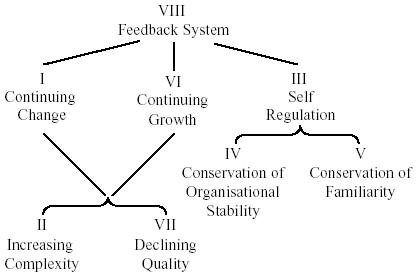
|
Publications on this area
Process Dynamics/Evolution/Change See also
Process Evolution
 GDPA Online
Last Updated 10.Apr.2002
Updated by Webmaster
Last Revised 10.Apr.2002
Revised by Webmaster
GDPA Online
Last Updated 10.Apr.2002
Updated by Webmaster
Last Revised 10.Apr.2002
Revised by Webmaster
|